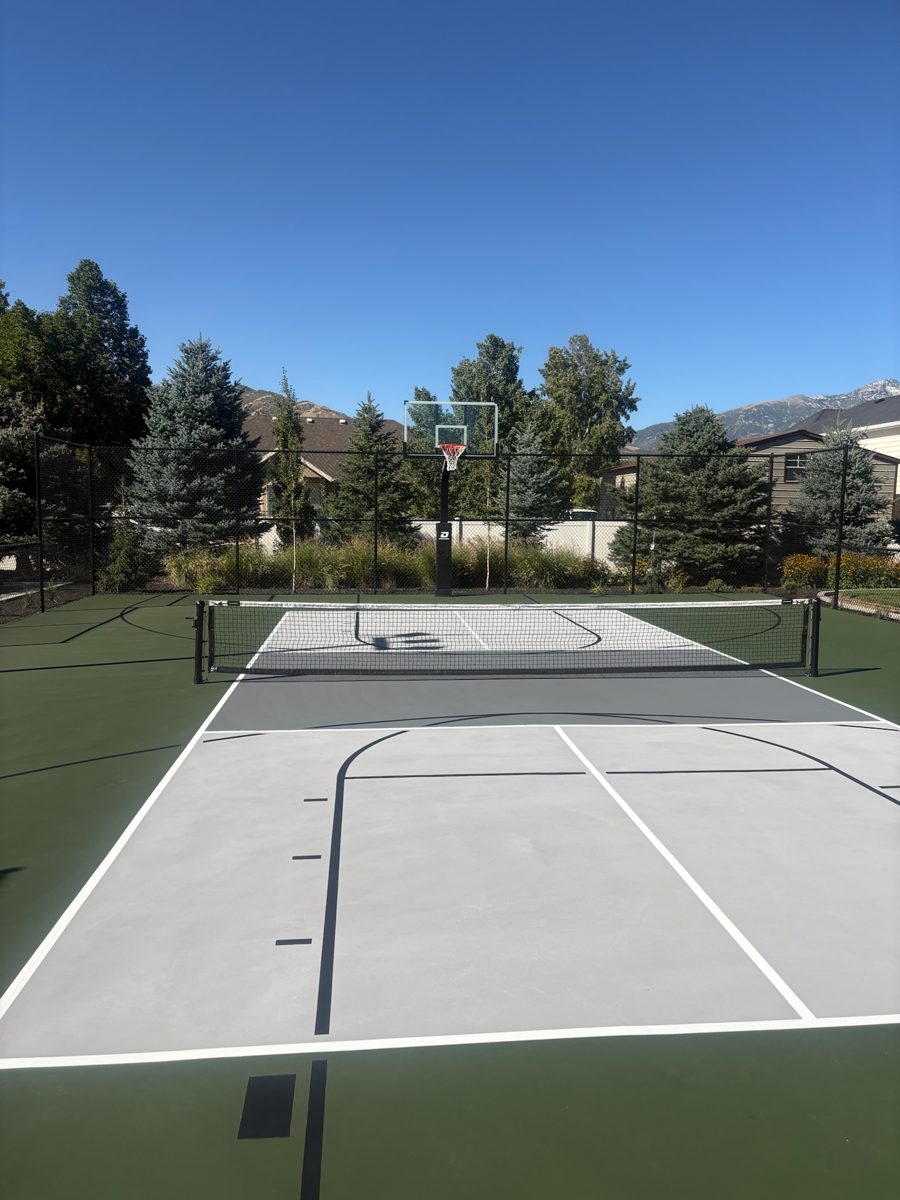
If you are considering building a backyard pickleball or basketball court in Utah, the most critical decision isn't the color of the paint or the brand of the net, it's what lies underneath the surface.
A homeowner in Lehi, Utah recently reached out to us with an all-too-common problem: they had invested in a brand-new concrete court just a couple of years prior, but the slab had already begun cracking, shifting, and separating.
Here is why standard concrete often fails for sports courts in Utah, and how we engineered a permanent, tournament-grade solution using post-tension concrete.
The Big Problem: Utah's Freeze-Thaw Cycle
Utah's climate creates severe stress on outdoor concrete slabs:
- Soil Settlement & Clay Expansion: Utah County soils frequently shift with groundwater fluctuations.
- The Freeze-Thaw Cycle: Moisture enters microscopic concrete pores, freezes during cold winter nights, expands by roughly 9%, and thaws when the sun hits the court.
- Traditional Slabs vs. Control Joints: Standard driveways or patios use control joints (grooves cut into the slab) to dictate where concrete cracks. However, on a sports court, you cannot play across deep saw-cut expansion grooves, forcing standard slabs to crack randomly across the playing area.
When structural cracks run through a court, acrylic resurfacing layers stretch and tear, creating dead spots, tripping hazards, and erratic ball bounces.
Here's How We Made This Court
Step 1: Complete Demolition & Subgrade Stabilization
Because the existing slab lacked the structural tensile strength needed to resist settling, surface patching would have only delayed another crack. We broke out and hauled away the damaged concrete, excavated the soil, and compacted an engineered road-base foundation.
Step 2: Engineered Post-Tension Concrete Slab
Instead of standard rebar or wire mesh, we installed an engineered grid of high-strength steel cables encased in plastic sheathing.
- Once the concrete reached initial cure strength, our team used a specialized hydraulic jack to pull each tendon under thousands of pounds of tension.
- This process places the entire concrete slab into permanent structural compression, actively squeezing the concrete together and virtually eliminating structural cracking.

Step 3: Custom Acrylic Color & Dual-Striping
Once fully cured and acid-etched:
- We applied a multi-layer tournament acrylic surfacing system featuring an earthy forest green exterior, slate gray playing zone, and a charcoal gray non-volley zone (kitchen).
- We snapped precision regulation white lines for pickleball and overlaid black basketball key striping with a heavy-duty in-ground hoop for maximum multi-sport versatility.
- We finished the enclosure with high-impact, sleek black chain-link fencing to keep balls on the playing surface.


Is Post-Tension Concrete Worth the Investment?
While a post-tension court carries a slightly higher upfront cost than standard flatwork concrete, it prevents the $25,000 expense of having to tear out and replace a failed pad a few years down the line.
For luxury backyard courts built to withstand decades of heavy play and harsh Utah seasons, post-tension is the gold standard used in commercial tournaments and backyards nationwide.

Planning a Court in Utah County or Salt Lake?
Whether you have an existing court that needs a structural evaluation or you are planning a new build from the ground up, our team handles excavation, post-tension pours, acrylic surfacing, fencing, and equipment installation. Fill out our form to get a free quote!